
Oconee Court Records After Arrest
The Oconee County jail roster and the South Carolina court record answer different questions. The roster is a custody record for people currently held at the Oconee County Detention Center. It can show the held-for agency, arrest date, warrant or ticket text, statute code, bond type, bond amount, judge, mugshot, and added holds. The court record after an arrest lives in the South Carolina Judicial Branch Public Index for Oconee County and in the clerk or court office that maintains the criminal case file.
That split matters because a booking charge is not always the final charge. A person may be booked on a warrant, ticket, probation hold, or officer-listed offense, then the Tenth Judicial Circuit Solicitor or a lower court process may file a formal case with different wording. For custody and booking detail, use the Oconee County jail inmate records page. For booking photos, the natural place is the Oconee County jail mugshots page. The court record is where the filed charge, court events, status, and disposition belong.
Oconee County is listed by the South Carolina Judicial Branch as Circuit 10, County 37. Criminal matters can involve magistrate court, municipal court, or General Sessions, depending on the charge and procedural path. A released defendant can still have an open court case, and a person in custody can have several cases or holds at once.
Oconee Public Index Case Search
The official starting point for Oconee County court records after a jail arrest is the South Carolina Judicial Branch case records search. The county-specific search is the Oconee County Public Index. The index is separate from the Sheriff's roster, so the best search often uses both: first collect the exact name, arrest date, held-for agency, and statute text from the jail entry, then compare those facts with the court case.
The Oconee County Public Index page is shown in the captured research image below.
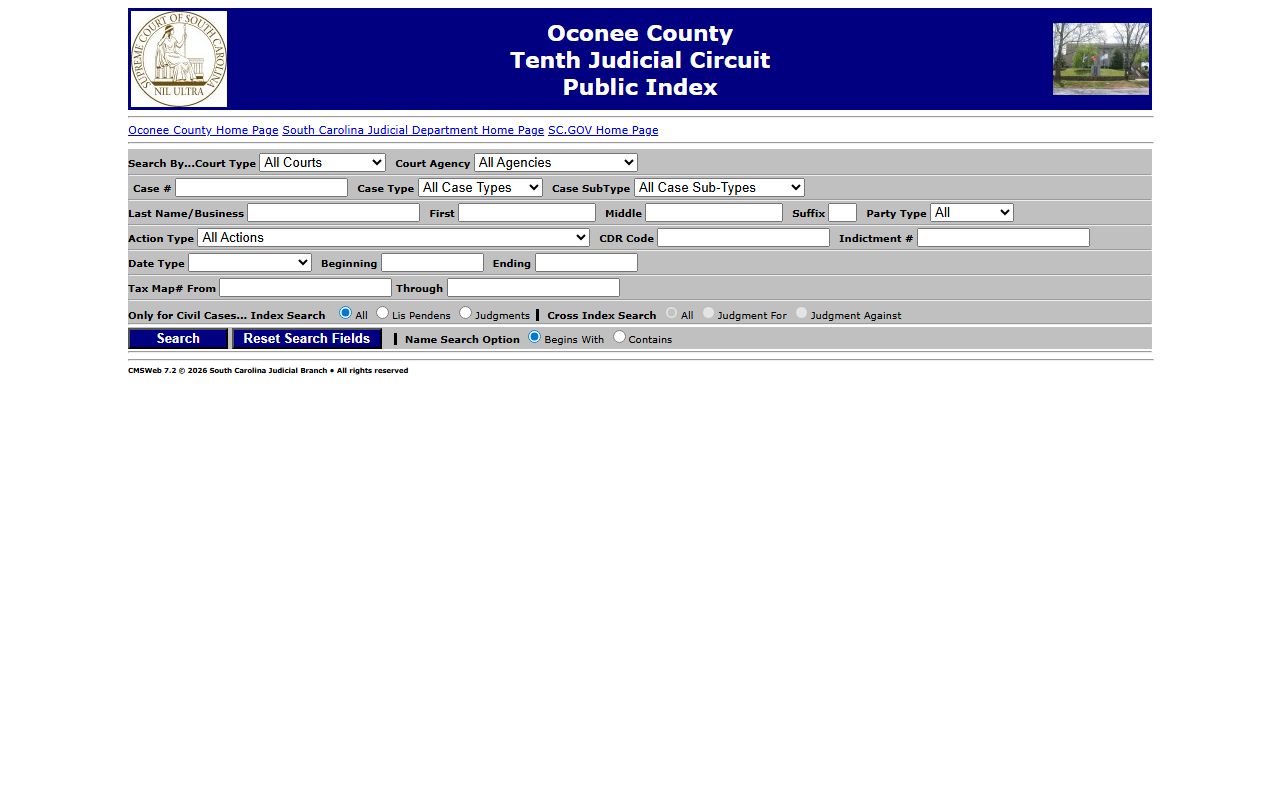
The screenshot shows the court-side portal used after a jail arrest, not the jail roster itself.
| Public Index Field | Type | Required | How It Helps |
|---|---|---|---|
| Court Agency / County | Dropdown or county URL | Yes by page | The Oconee URL preselects the county index. |
| Case Number | Text | No | Best when the exact criminal case number is known. |
| Name | Text | No | Useful for defendant or party searches after arrest. |
| Search Type | Option | No | Public Index interfaces commonly allow name or case-number variants. |
| Date Fields | Date | No | Use filing or action dates when the browser view offers them. |
Find Court Records After Oconee Arrest
A careful search follows the arrest-to-case path. Start with the Oconee current-inmates roster when the person may still be in jail. It can supply name spelling, age instead of full date of birth, arrest date, agency, warrant number, charge code, and bond terms. Then move to the Public Index to see whether a court case has been filed or updated.
- Open the Sheriff's inmate-search landing page and check the current roster if custody is still possible.
- Write down the defendant name, arrest date, held-for agency, statute, warrant or ticket number, and bond entries.
- Open the Oconee County Public Index and search by last name and first name, or by case number if known.
- Compare the filing date, charge text, bond events, and court level against the booking record.
- Open each matching criminal case because one arrest can produce more than one case or hold.
If the online case search does not answer the question, the county directory lists Lisa Burton as Oconee County Clerk of Court, with phone 864-638-4283 and PO Box 678, Walhalla, SC. Older files, certified copies, and records that do not render cleanly online may require the clerk or the court office. Law-enforcement incident or booking material is a separate public-records request route under the South Carolina Freedom of Information Act.
Oconee Arrest Charging Documents
After an Oconee County arrest, the jail creates an intake record, but the court case is built from charging documents. South Carolina practice can involve complaints or warrants in lower-court matters, Solicitor-filed charges for General Sessions cases, and grand jury indictments for serious felony prosecution. The exact document controls what the court is being asked to decide.
| Document Type | Who Uses It | Common Role After Arrest | What to Check |
|---|---|---|---|
| Complaint or warrant | Officer, magistrate, or prosecutor path | Often tied to the first criminal accusation or arrest authority. | Warrant number, statute, judge, and bond text. |
| Information or formal charge | Prosecutor | Reflects the charge path selected after report review. | Charge wording, court level, and amended counts. |
| Indictment | Grand jury | Used for serious felony cases moving through General Sessions. | Indictment number, count list, and later disposition. |
The Tenth Judicial Circuit Solicitor prosecutes criminal cases for Oconee County and Anderson County. The jail records the custody side; law-enforcement reports go to prosecution; the Solicitor evaluates General Sessions charges; and magistrate or municipal matters may continue in lower courts. That is why court records after an arrest should be checked after the booking entry, not treated as the same thing.
Oconee Charge Status Records
Charge status terms show where a count stands. The roster may show a hold reason or bond amount before the court file is complete. The Public Index can later show whether the charge is still pending, amended, reduced, dismissed, nol prossed, or resolved by plea or verdict. A status term is not just a label. It can change whether the person still has court dates, whether a warrant can issue, and whether an expungement question is worth asking.
| Status | Plain Meaning | Why It Matters |
|---|---|---|
| Pending | The case or charge has not reached final disposition. | Hearings, bond terms, and future court dates may still apply. |
| Amended | The charge wording or count has changed. | The court charge may differ from the jail booking text. |
| Reduced | The accusation is lowered to a lesser charge. | Possible penalties and court level may change. |
| Dismissed | The charge has been ended by court or prosecution action. | Dismissal is not the same as expungement from all public access. |
| Nolle prosequi | The prosecutor will not continue the charge. | The case may close, but the arrest record may still need separate review. |
| Guilty plea or verdict | A conviction has been entered. | Sentencing, SCDC transfer, fines, probation, or jail time may follow. |
Bond Warrants and Court Release
Oconee roster samples showed bond type, amount, and the judge who set bond. Examples included surety and personal recognizance bonds, with amounts shown per warrant or charge. South Carolina bond and recognizance rules are in Title 17, Chapter 15. The local record point is simple: a defendant may have more than one charge, more than one bond entry, and an additional hold that prevents release even when one bond can be posted.
| Bond or Hold Type | How It Works in Oconee Records |
|---|---|
| Personal recognizance | Release is based on a promise to appear. This was observed in Oconee roster samples. |
| Surety | A bondsman or surety secures release. This appeared often in the public samples. |
| Cash | South Carolina allows secured financial conditions, but no Oconee cash-only procedure was located. |
| No-bond hold | Release may be barred, not set, revoked, or blocked by another custody reason. |
| Additional hold | Probation, GPS, DCT, another county, or another agency may keep the person jailed. |
No standalone official active-warrant search was located for Oconee County. Warrant detail appears in current-inmate records after booking, including arrest warrants, ticket warrants, statute text, charge descriptions, and issuing jurisdiction. A bench warrant may also appear through court records when a person fails to appear or violates an order. Warrant resolution may require counsel, a court appearance, bond, or surrender through the proper agency.
Oconee Charges vs Convictions
An arrest is not a conviction. A charge is an accusation that can be reviewed, changed, dismissed, or proven. A conviction requires a guilty plea, verdict, or judgment. Oconee County court records after arrest should be read with that sequence in mind, especially when a roster entry looks serious but the Public Index later shows a different outcome.
| Point of Comparison | Charge | Conviction |
|---|---|---|
| Stage | Accusation after arrest or filing. | Outcome after plea, verdict, or judgment. |
| Proof Level | Based on probable cause or a filed accusation. | Requires proof beyond a reasonable doubt or a valid plea. |
| Public Access | Often public unless restricted by law. | Often public, but still subject to record rules. |
| Search Method | Check jail roster, warrant text, and Public Index. | Check disposition, sentencing, probation, or SCDC transfer. |
Sealed Expunged Oconee Arrest Records
Public access has limits. The South Carolina FOIA opens many public records, but Section 30-4-40 allows law-enforcement exemptions and redactions when release would interfere with enforcement, fair trial rights, confidential sources, safety, or other protected interests. Juvenile matters also have different confidentiality rules under Title 63, Chapter 19.
| Access Limit | What It Means | Oconee Search Effect |
|---|---|---|
| Sealed | Hidden from normal public view by law or order. | The public index or requester may see little or no case detail. |
| Expunged | Eligible criminal records are removed from public access under state law. | Later searches may not show the arrest or charge in the usual way. |
| Juvenile restricted | Minor records and proceedings have special confidentiality limits. | Adult roster and Public Index rules should not be assumed. |
South Carolina's expungement framework is in Title 17, Chapter 1. A dismissal or nolle prosequi does not always erase every public trace on its own. The person or counsel may need to review eligibility, the court file, and the proper expungement process.
When Oconee Records Move
Some people arrested in Oconee County later leave the county jail system. A state-prison sentence moves lookup to the South Carolina Department of Corrections inmate search, not the Oconee jail roster. Federal sentenced custody belongs in the BOP Inmate Locator. Immigration detention belongs in ICE ODLS. Custody alerts may also be available through VINELink.
Important: A court charge, a jail booking, and a conviction are separate records; verify each one with the originating office.